The Monsoon Failed The South And The Northeast
Between 1 June and 30 September 2026 India received 759.4 mm of monsoon rain, 87% of normal, the fourth-lowest since 2001 and the 13th-lowest since 1901, in a season the India Meteorological Department said was under the impact of El Niño. The shortfall was not spread evenly. East and Northeast India had its lowest monsoon rain since 1901, at 74% of normal, and the South Peninsula its fourth-lowest, at 76%. Central India and the Northwest ended close to normal. Of IMD’s 36 meteorological subdivisions, 17 were deficient and only Odisha had excess rain. India’s boundary is shown as drawn by the Survey of India.
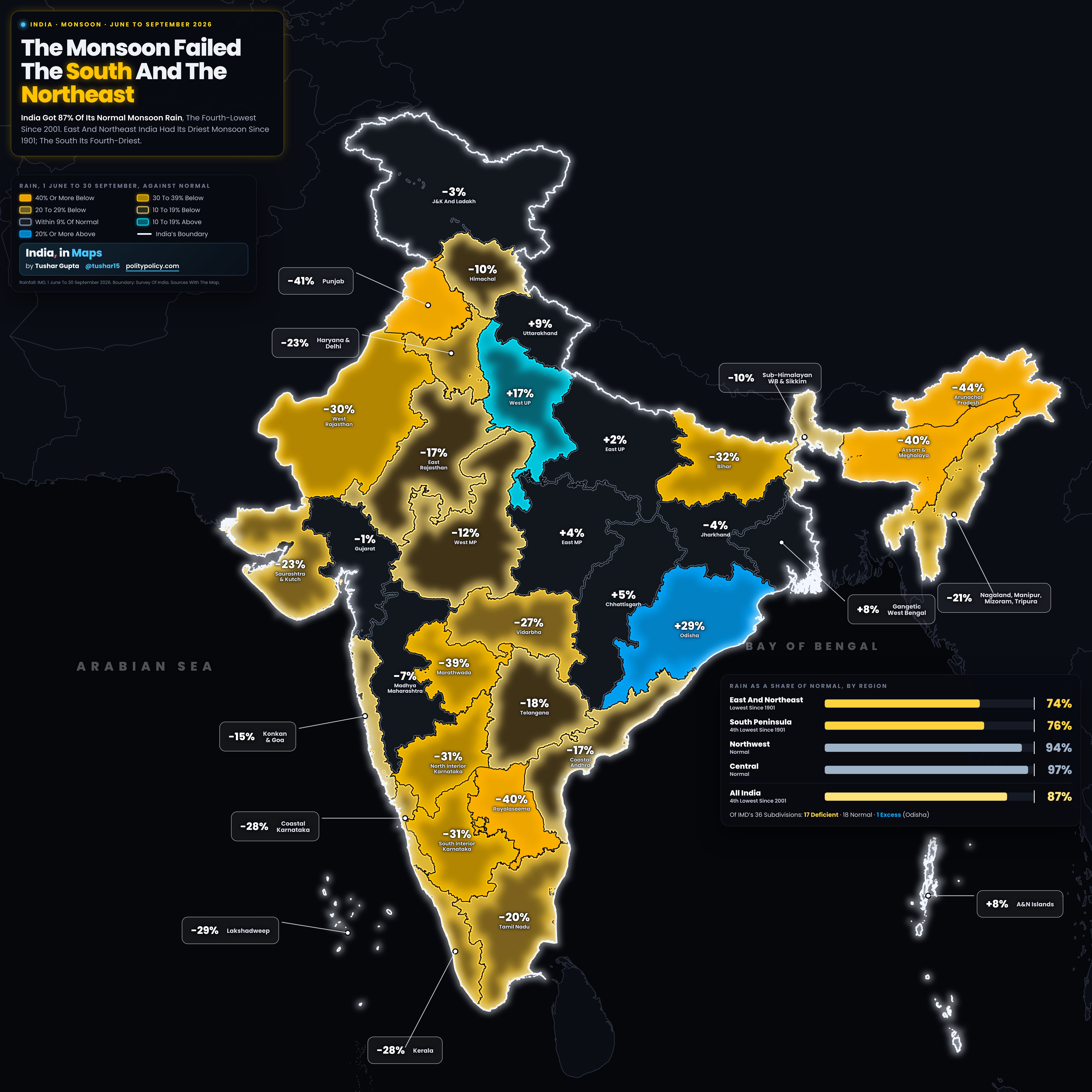
- Each shape is one of the India Meteorological Department’s 36 meteorological subdivisions, the units in which IMD reports rainfall. The number is how far its rain from 1 June to 30 September 2026 fell short of, or exceeded, its normal.
- Gold marks a deficit: the stronger the gold, the drier, from a faint wash at 10 to 19% short to solid gold at 40% or more. Subdivisions within 9% of normal are left dark, and blues are surpluses.
- IMD counts a subdivision as deficient at 20% or more below normal and normal within 19% either way. By that measure 17 subdivisions were deficient, 18 normal and one, Odisha, in excess.
- The panel at bottom right gives rain as a share of normal for IMD’s four regions and India as a whole.
- India’s boundary is the Survey of India’s.
The Northeast: Driest Since 1901
East and Northeast India received 1,016.3 mm against a normal of 1,367.3 mm, 74% of normal and its lowest since 1901. Arunachal Pradesh was 44% below normal, Assam and Meghalaya 40%, Bihar 32%, and Nagaland, Manipur, Mizoram and Tripura 21%. Only Gangetic West Bengal, at 8% above, had more rain than normal.
The South: Fourth-Driest Since 1901
The South Peninsula got 542.0 mm against 716.2 mm, 76% of normal, its fourth-lowest since 1901 and second-lowest since 2001. Of the southern mainland subdivisions, only Telangana and Coastal Andhra escaped the deficient category: Rayalaseema was 40% below normal, North and South Interior Karnataka 31% each, Coastal Karnataka and Kerala 28%, and Tamil Nadu 20%. Reservoirs in southern India held 50% of their live storage on 24 September.
Normal Totals That Hide Dry Patches
Northwest India ended at 94% of normal and Central India at 97%, both within IMD’s normal range. Within them, Punjab was 41% below normal, Marathwada 39%, West Rajasthan 30% and Vidarbha 27%, while West Uttar Pradesh was 17% above and Odisha 29% above, the only subdivision in excess.
A Dry June, Then Patchy
The season began badly: June rain was 65% of normal, with 22 of 36 subdivisions deficient. July recovered to 101%, before August fell back to 84% and September ended at 92%. IMD said the season was under the impact of El Niño; its Director General, Mrutyunjay Mohapatra, said the impact was greater in the southern and eastern parts of the country.
Rain from 1 June to 30 September 2026 against normal, by IMD’s meteorological subdivision. IMD counts 20% or more below normal as deficient and 20% or more above as excess.
Sources And MethodShow
Rainfall by subdivision: India Meteorological Department, Hydromet Division, Subdivision Rainfall Map for 1 June to 30 September 2026 (Annexure II of IMD’s extended range forecast, 1 October 2026). All-India and regional figures, rankings and category counts: IMD, Salient Features of Southwest Monsoon 2026, 30 September 2026. Monthly figures: IMD, via ETV Bharat and Business Standard, 30 September 2026. IMD Director General Mrutyunjay Mohapatra and reservoir storage: Business Standard, 30 September 2026. Map: Survey of India boundary and state boundaries via DataMeet India community (CC BY 4.0); IMD subdivisions drawn from those states and DataMeet’s 2011 district boundaries (CC BY 4.0), approximate where IMD splits a state; neighbours: Natural Earth (public domain).